IEC vs. UL: Key Differences in Electrical Certification
November 18, 2026
IEC and UL are two certification systems that are often mentioned in international markets. They play important roles in ensuring electrical safety, product reliability, and regulatory compliance. However, they differ significantly in their certification systems, market acceptance, testing procedures, and compliance costs. In this article, we will explore IEC and UL certifications in detail, compare their key requirements, and explain how to make a more informed certification decision for electrical products.
What Is IEC Certification and Its Significance
IEC Certification
The International Electrotechnical Commission (IEC), founded in 1906 and headquartered in Geneva, Switzerland, is the world’s most authoritative international standards organization for electrotechnology and electronics, with members from over 170 countries and regions.
It is important to note that IEC is responsible for developing and publishing standards. It does not directly issue “certification”. What we commonly refer to as “IEC certification” actually refers to product testing and certification systems based on IEC standards, such as the IECEE CB System. This system enables mutual recognition of test results among member countries through a single CB test report and certificate, allowing enterprises to convert it into national certifications of target countries and avoid repeated testing.
Significance
• Global Pass: The entry requirements for electrical products in the vast majority of countries worldwide (including the EU, China, the Middle East, Southeast Asia, Africa, etc.) are based on IEC standards.
• One Test, Multi-Country Recognition: Through the CB System, one test can obtain recognition from over 50 member countries, significantly reducing export costs.
• Technical Common Language: IEC standards coordinate technical requirements for global electrical products, representing the lowest technical standard in international trade.
What Is UL Certification and Its Significance
UL Certification
Underwriters Laboratories (UL), founded in 1894 and headquartered in North Chicago, USA, is one of the world’s oldest and most renowned safety science organizations. Unlike the IEC, UL not only develops standards (such as UL 508A, UL 891, etc.) but also directly conducts product testing and certification.
In the U.S. market, while UL certification is not a legally mandatory requirement, it has de facto enforceability: The U.S. Occupational Safety and Health Administration (OSHA) mandates that electrical equipment used in workplaces must be certified by a Nationally Recognized Testing Laboratory (NRTL) that it recognizes, and UL is the most prominent NRTL. Additionally, the vast majority of U.S. insurance companies, fire departments, and building approval authorities only recognize products certified by NRTLs. Products without UL certification find it extremely difficult to enter the mainstream U.S. market.
Significance
• A ticket to the North American market: Access to the U.S. and Canadian markets (particularly in industrial and building electrical sectors) is almost impossible without NRTL certification such as UL or CSA.
• A symbol of safety credibility: The UL mark, with over a century of history, represents “safety” itself in the minds of buyers, insurers, and regulators.
• A basis for liability allocation: A product bearing the UL mark indicates a clear chain of responsibility between the manufacturer, certifying body, and testing institution, enabling traceability of liability in the event of a safety incident.
Recognition of Certification Marks and Certificate Styles
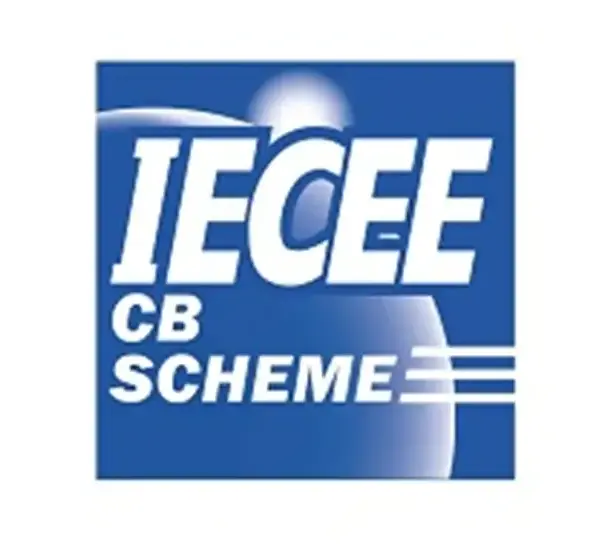
The CB certificate is a document-based system, not a labeling system. The presence of a CB mark on a product should be approached with caution. The correct way to verify the authenticity of a CB certificate is to check it using the certificate number in the IECEE certificate database from the IEC website (https://www.iecee.org/).
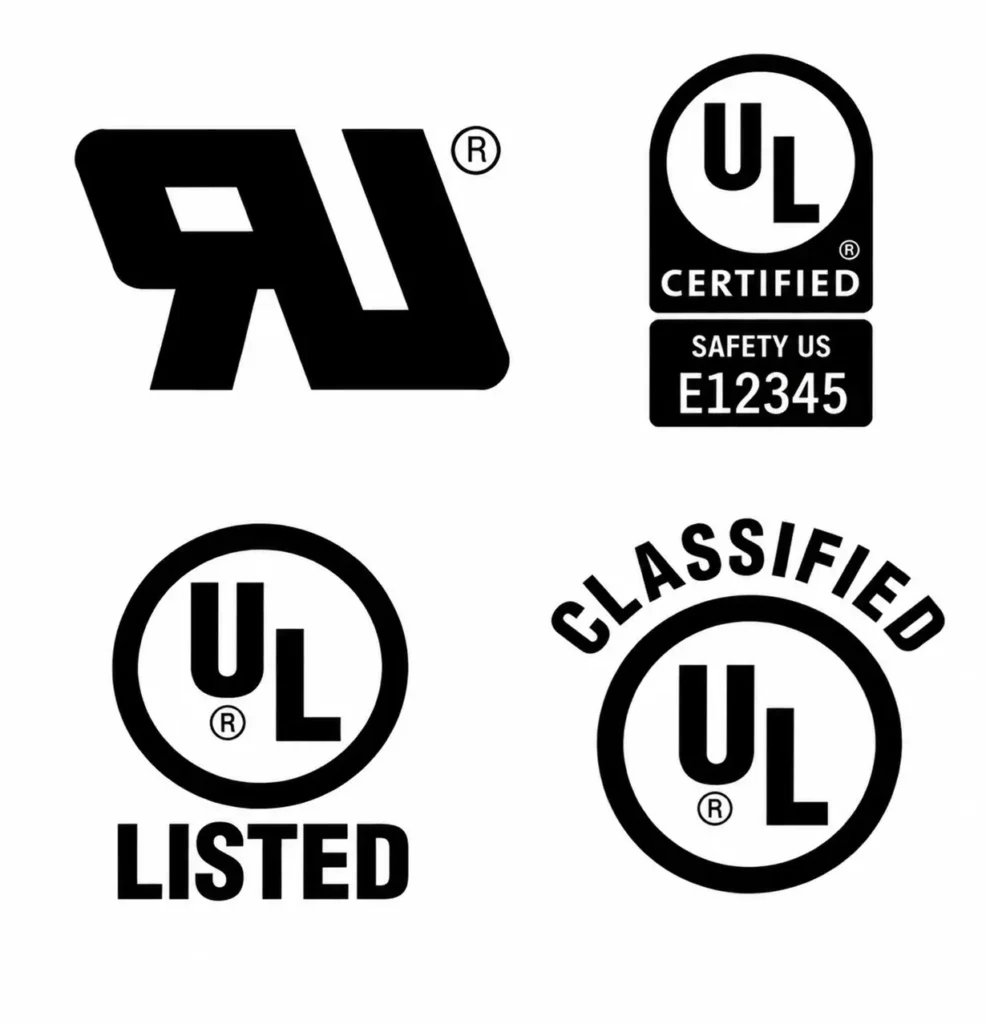
There are multiple variations of marks for the UL Solutions Listing service.
UL Listed applies to complete finished products e.g., an entire switchgear cabinet).
UL Recognized mark is a reversed-style UL with RU. This mark means the certification is only for components (e.g., circuit breakers, fuses, insulating materials).
UL Classified is certification for specific
properties or performance.
Certificate/Mark | Nature | Applicable Scope | Key Identification Points |
|---|---|---|---|
CB Certificate | International mutual-recognition test report | Worldwide (IECEE CB Scheme member countries) | Document-based system; can be converted into national certifications of member countries. |
UL Listed | Full product certification | The U.S.A. and Canada. For complete end products. | The mark is a circle with “UL” and includes the word “LISTED”. |
UL Recognized | Component certification | The U.S.A. and Canada. For components/parts. | The mark is a reversed-style UL with RU |
UL Classified | Certification for specific properties | The U.S.A. and Canada. For specific risks or performance aspects. | The mark is a circle with “UL” and includes the word “CLASSIFIED”. |
Comparison of Certification Processes, Cycles, and Costs
Certification processes, cycles, and costs are the most concerning issue for export enterprises, and the differences between them are quite obvious.
Comparison Item | IEC (CB) System | UL Certification |
|---|---|---|
Standard Source | Internationally adopted IEC standards | US-based UL standards |
Certification Path | Apply for CB testing → convert to target-country certificate | Apply directly to UL for listing |
Testing Organization | Any accredited CBTL laboratory | UL’s own labs or UL-recognized labs |
Typical Timeline | 4–8 weeks | 6–12 months (longer for complex products) |
Initial Cost | Relatively low, thousands of USD | Relatively high, typically starting at tens of thousands of USD |
Ongoing Cost | Certificate maintenance costs are relatively low | Quarterly factory inspections+ annual fees, relatively high. |
Factory Inspection | Conducted at certificate update; some countries waive the factory audit | Mandatory and continuous; quarterly follow-up inspections |
Common IEC Ratings and UL Rating Levels
The rating systems of the two frameworks are not equivalent and are often confused during procurement. The following are the main comparisons.
IP Rating
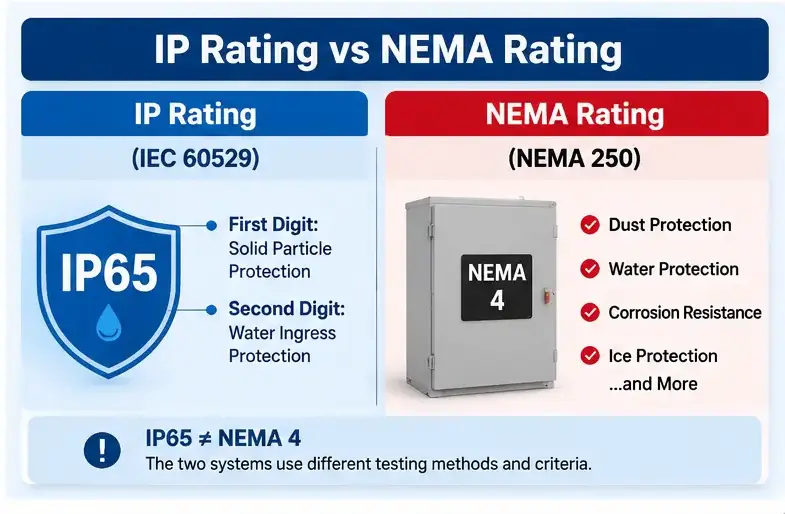
Environmental Requirement | IEC System | UL / NEMA System |
|---|---|---|
General indoor protection | IP20 / IP30 | NEMA 1 / NEMA 12 |
Rain protection | IPX3 / IPX4 | NEMA 3R |
Splash / hose-directed water protection | IP54 / IP55 | NEMA 4 |
Corrosive environments | IP65 (with additional material requirements) | NEMA 4X |
Highest dust & water protection | IP66 / IP67 / IP68 | NEMA 6 |
Heat Resistance Class
Common IEC insulation material heat resistance classes (Class A: 105°C, Class E: 120°C, Class B: 130°C, Class F: 155°C, Class H: 180°C);
UL also uses these heat resistance classes, but the reference conditions for temperature rise testing and measurement methods differ. As a result, the temperature rise measured for the same device using the two sets of standards may vary.
Pollution Class and Overvoltage Category
This is an IEC-specific concept (Pollution Classes 1–4, Overvoltage Categories I–IV), used to determine electrical clearances and creepage distances; UL standards have similar requirements but use different expressions and value systems.
Differences in Testing Methods and Standards for Switchgear Products
Core Standard Correspondence between IEC and UL
Product Category | IEC Standards | UL Standards |
|---|---|---|
Low-voltage switchgear assemblies | IEC 61439-1 / -2 | UL 891 (switchboards), UL 1558 (metal-clad switchgear) |
Low-voltage circuit breakers | IEC 60947-2 | UL 489 |
Industrial control panels | IEC 61439-1 | UL 508A |
High-voltage switchgear | IEC 62271 series | UL 1558 / IEEE C37 |
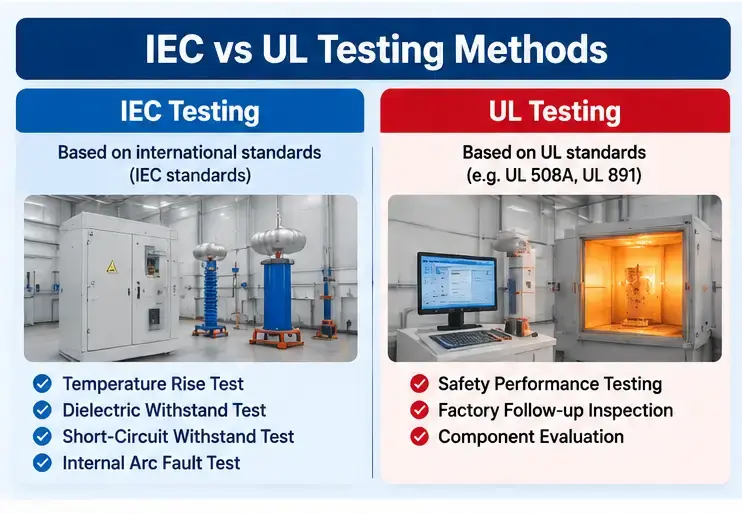
Key Differences in Main Test Items
Temperature Rise Test
• IEC 61439: Conducted using the agreed-upon heating current, with temperature rise limits based on specified values for copper conductors (e.g., ≤60K for bare copper connections). Typical load is applied during testing.
• UL Standards: The temperature rise test places greater emphasis on actual installation conditions (e.g., wire sizes and installation methods per NEC), with different arrangements of measurement points and calculation methods for test current.
Dielectric Withstanding Test
• IEC: Power frequency withstand voltage, with test voltage determined by system voltage and overvoltage category. Application time is 1 minute.
• UL: Uses 60Hz or DC withstand voltage, with test voltage values and withstand times differing from IEC, often being more stringent or based on different calculation criteria.
Short-Circuit Withstand Test
• IEC: Complete equipment sets must verify the rated short-time withstand current (Icw) or validate through coordination with short-circuit protective devices.
• UL: Places stronger emphasis on performance under rated short-circuit current. Post-test criteria for equipment (e.g., whether cabinet doors can be opened, arc flash limitation) differ.
Internal Arc Test
• IEC 62271-200 (high voltage) and IEC TR 61641 (low voltage) specify internal arc fault tests, which are important requirements in European and high-end markets in recent years.
• The UL system historically had fewer systematic requirements for internal arcs compared to the IEC system, but North America has been gradually strengthening this in recent years. Please refer to this blog if you would like to learn more about arc flash in switchgear.
Common Misconceptions
Misconception 1: “Having a CE mark means it is IEC certified.”
❌ Incorrect. CE is a conformity declaration under EU regulations. Most low-voltage electrical products fall under the self-declaration category, allowing manufacturers to affix the CE mark without any laboratory testing. In contrast, IEC certification refers to testing and certification issued by third-party organizations based on IEC standards.
Misconception 2: “UL certification is globally applicable.”
❌ Incorrect. The UL mark is most authoritative in North America (the United States and Canada). In Europe, the Middle East, and Asia, customers generally recognize CB certificates (based on IEC standards) plus regional-specific standards. A cabinet with only UL certification and no IEC test basis is typically not accepted by European project tenders.
Misconception 3: “IEC ratings can be directly converted to UL ratings.”
❌ Incorrect. Testing methods and criteria are different, and there is no official conversion table. The correct approach is to obtain certification according to the target market’s standards separately.
Misconception 4: “Obtaining a certification can guarantee lifelong insurance.”
❌ Incorrect. UL certification includes quarterly factory inspections, and listing can be revoked if there is any inconsistency between certification and actual production. CB certificates also have an inspection system. The models and specifications on the certificate must match the supplied products; “one certificate for multiple uses” has great risk.
Conclusion
The divergence between IEC and UL certifications essentially reflects the difference between two logical frameworks: the”internationally recognized system” and the “North American indigenous system.” IEC excels in global mutual recognition and lower costs, while UL stands out for its absolute authority and century-old credibility in the North American market. As UL increasingly adopts IEC standards and IEEE and IEC continue coordination in high-voltage areas, the two systems are gradually converging. However, in the foreseeable future, “doing UL for North America and CB for the global market” will remain the most practical dual-track strategy for electrical enterprises.