How AI Is Reshaping Data Center Power Infrastructure
November 18, 2026
Much of the debate over AI and electricity has focused on whether data centers will overwhelm the power grid. Grid capacity remains a concern, but it is only part of the problem. Inside data centers, AI is driving a rapid rise in rack-level power density.
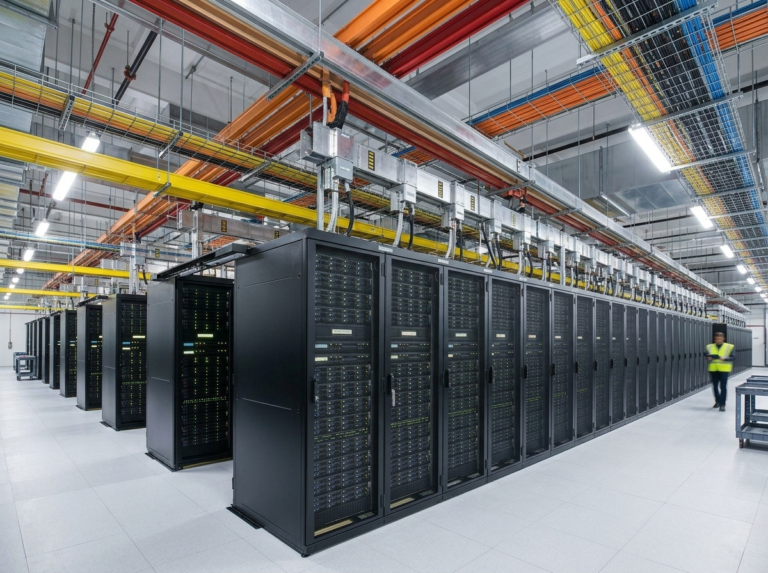
According to the IEA, global data center electricity consumption is projected to nearly double, from 485 TWh in 2025 to 950 TWh in 2030, accounting for around 3% of global electricity demand. The 2026 estimate stands at approximately 560 TWh. Meanwhile, hyperscalers are expected to spend more than $700 billion in capital expenditure in 2026, exceeding annual global investment in oil and gas production.
More generation capacity and additional grid connections can help meet rising electricity demand. But they cannot solve the constraint inside the rack, where the same footprint may need to support five to six times as much power without any increase in space. That puts existing power delivery and distribution designs under pressure, especially as electrical loads become more dynamic.
Rising Power Density Is Changing Data Center Infrastructure
Rack power requirements have changed sharply across successive generations:
Timeframe | Power per Rack | Rough Equivalent |
|---|---|---|
Traditional cloud data centers | 10–30 kW | Several to a dozen household air conditioners running simultaneously |
Hopper-era AI racks | Around 50 kW | About 17 household air conditioners |
Blackwell generation | Around 130–150 kW | Roughly 40–50 household air conditioners |
Rubin Ultra | 600 kW or more | Around 200 household ovens |
Feynman generation | 1 MW | Around 330 household ovens |
Take 48 V DC distribution as an example. Rack-level systems have traditionally used low-voltage DC because the components are mature and protection practices are well established. The trade-off is high current: delivering 600 kW at 48 V requires 12,500 A.
- Oversized copper busbars. The copper cross-section needed to carry 12,500 A makes the busbars bulky and heavy, making them difficult to fit and support within a standard rack.
- Excessive heat generation. Resistive heating in copper busbars increases with the square of the current. The rack’s cooling system must remove the additional heat.
- Limited rack space. NVIDIA estimates that, at megawatt scale, retaining a 54 V DC main bus could require up to 64U of rack space for power shelves alone. That exceeds the 42–48U available in a typical standard rack.
Inside the rack, busbars, liquid-cooling pipes, cables and structural components all compete for space alongside the compute hardware. Power distribution design has traditionally focused on maintaining acceptable voltage drop. At these power levels, engineers must also account for busbar temperature rise and the space taken up by distribution equipment.
Power Distribution Architectures Are Evolving for AI Workloads
As current becomes a limiting factor, raising the distribution voltage offers the most direct solution. A 48 V system needs approximately 5,200 A to deliver 250 kW. At 800 V, the same power requires just 313 A. Google, Microsoft, and NVIDIA are advancing common 800 VDC specifications through the Open Compute Project (OCP), with more than 80 industry partners developing compatible infrastructure. The industry is now moving beyond the early exploration of 800 VDC toward a common approach to AI data center power distribution.
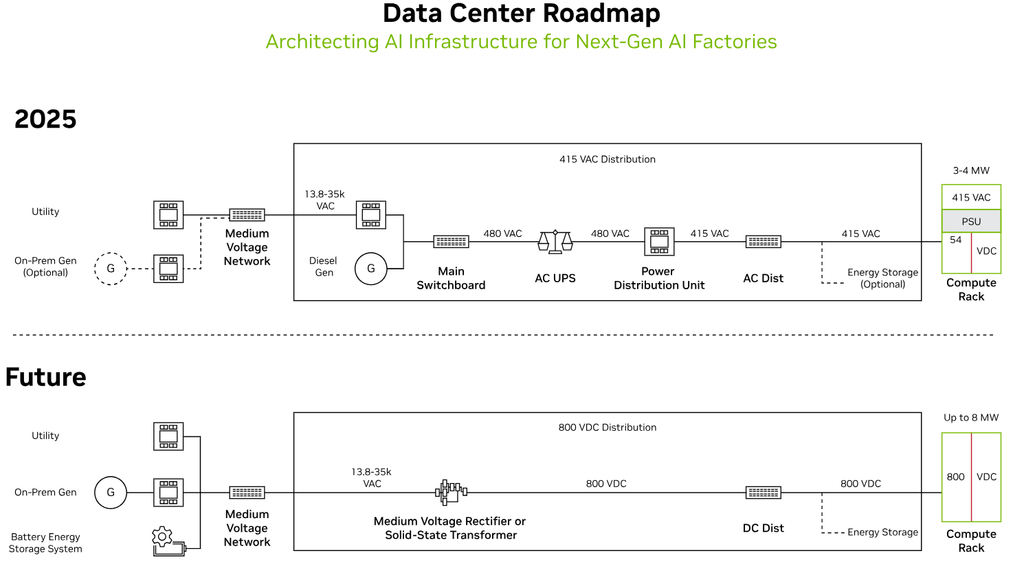
An 800 VDC architecture also changes the physical layout of power and computing equipment. In a sidecar configuration, AC-to-DC conversion and power distribution equipment sit in a dedicated cabinet beside the IT rack, freeing rack units for additional compute trays. Schneider Electric and NVIDIA are collaborating on a sidecar designed to support racks of up to 1.2 MW. Separately, Delta showcased a 660 kW 800 VDC in-row power rack at GTC 2026.
With the power cabinet outside the IT rack, technicians must account for three changes:
- Longer power distribution paths. Busbars or cables connect the power cabinet to the compute rack. Engineers must account for voltage drop and resistive losses along the longer path.
- A shift in heat generation. The conductors still carry currents of 150–300 A, and resistive losses continue to generate heat. The heat is now released outside the IT rack, in the space between racks.
- New protection and maintenance. Engineers must plan zone protection, maintenance access, and fault isolation across adjacent racks.
Wider deployment of 800 VDC will depend on reliable DC protection, effective fault isolation, and interoperability across vendors. Protection equipment must not erode the space and cost savings that higher-voltage distribution is intended to deliver.
Managing Power Fluctuations and Reliability in AI Data Centers
Conventional data centers generally draw power at a relatively steady rate. Their UPS systems bridge interruptions in utility supply, while diesel generators provide longer-duration backup. AI training puts greater demands on this setup. During training, GPUs alternate between compute-intensive and communication-intensive phases. An individual GPU’s power draw can fall from near peak to near idle within milliseconds. Across a synchronized training cluster, these swings can reach tens or even hundreds of megawatts. A 2025 study, Power Stabilization for AI Training Datacenters, found dominant cluster-level oscillation frequencies in the 0.2–3 Hz range.
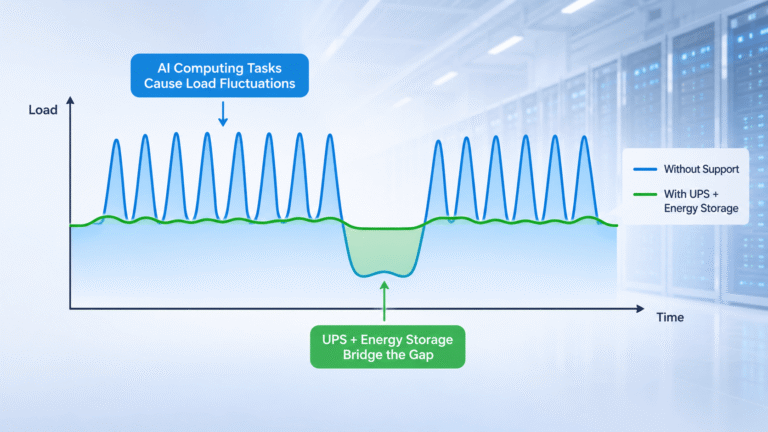
If the UPS rectifier cannot respond quickly enough to a sudden increase in demand, the DC-link voltage may sag, forcing the battery to supply the shortfall and maintain a stable inverter output. Repeated high-current charge and discharge cycles can accelerate battery degradation.
The current engineering approach is to allocate power resources according to their response times.
Time Scale | Resource / Service | Primary Role |
|---|---|---|
Milliseconds | Supercapacitors, flywheels | Cover the fastest power transients |
Seconds to minutes | Battery energy storage | Smooth fluctuations and provide backup power |
Minutes and beyond | Grid-side resources | Support peak shaving and longer-term supply-demand balancing |
Rectifier controls also need careful tuning. An overly aggressive response can amplify power swings on the grid side, while a slow response may fail to keep pace with load changes. In 800 VDC systems, DC arc-fault protection must detect and clear faults within milliseconds. Normal load transients can occur over a similar timescale, so protection schemes must distinguish between expected load changes and actual faults. DC protection standards are still evolving. Widely accepted DC arc-flash models and coordinated zone-protection frameworks are not yet established, and different equipment vendors may use different criteria to identify a fault.
Conclusion
The expansion of AI computing is putting pressure on data center power infrastructure. Higher rack power densities are driving changes to power distribution layouts. Those changes affect where protection is needed, while fluctuating loads place greater demands on system controls.
Delivery timelines for transformers, switchgear, DC protection equipment, and energy storage systems all affect how quickly new computing capacity can come online. Standards for new architectures such as 800 VDC, along with control strategies and validation processes, must also keep pace with changing load requirements. AI chip generations advance quickly, but power infrastructure often takes longer to design, approve, and build. The mismatch between these timelines is becoming a practical constraint on how quickly new AI data center capacity can come online.