
Load Break Switch vs. Circuit Breaker: Key Differences in Medium-Voltage Systems
A load break switch (LBS) opens and closes circuits under normal load. It can break rated load current, but it can’t clear a short-circuit fault on its own. A circuit breaker (CB) does both — it switches circuits normally, and it can interrupt fault currents within its rated breaking capacity.
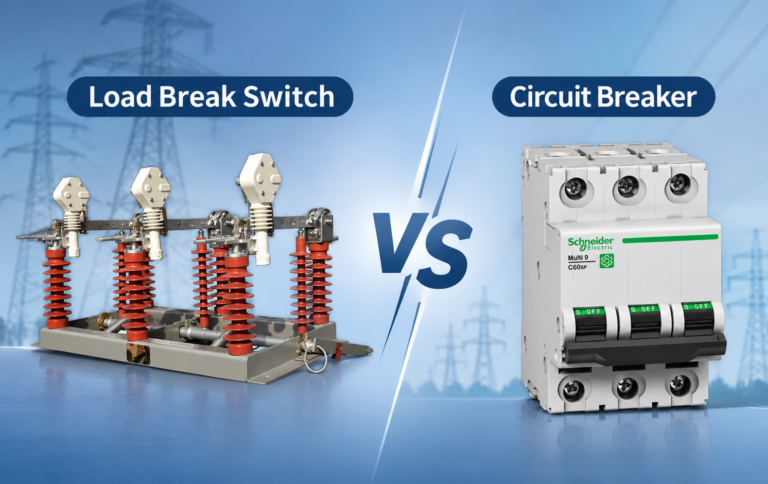
Load Break Switch and Circuit Breaker Comparison
The key difference is how they handle faults. A load break switch usually relies on an upstream protective device or a fuse for fault protection. A circuit breaker, by contrast, works as part of a protection setup with protective relays and current transformers. In some medium-voltage systems, you’ll find both devices in the same distribution network.
Comparison | LBS | CB |
|---|---|---|
Primary Function | Switching normal load current | Switching normal load current and interrupting fault current |
Load Current Switching | Yes, within rated limits | Yes, within rated limits |
Short-Circuit Interruption | Cannot independently interrupt short-circuit current | Can interrupt short-circuit current within its rated breaking capacity |
Short-Circuit Making Capacity | Available in accordance with its rated capacity | Available in accordance with its rated capacity |
Short-Time Withstand Current | Has a specified rating, depending on the design | Has a specified rating, depending on the design |
Protection Arrangement | Usually relies on fuses or upstream protective devices for fault clearance | Works with protective relays and a trip mechanism |
Typical Applications | Ring main units, cable feeders and distribution networks | Transformer feeders, incoming feeders and circuits requiring circuit protection |
Both devices can perform normal switching operations, but they play different roles in a fault situation. A load break switch can be rated to resist a short-circuit current for a specified period. This does not mean it can interrupt that current. The circuit breaker is intended to perform that interruption provided that the fault level does not exceed its rated breaking capacity.
How Do LBS and CB Handle Short-Circuit Faults?
A short-circuit fault drives current far above normal levels. The switching device must either interrupt this current or withstand it until another protective device clears the fault. Load break switches and circuit breakers handle this situation differently.
What Does a Load Break Switch Do During a Short Circuit?
When a short circuit occurs while a load break switch is closed, the fault current passes through its contacts. The LBS does not automatically interrupt the current. Another protective device must clear the fault before the switch exceeds its specified short-time withstand limit.
That said, an LBS still has to survive electrical and mechanical stresses a fault throws at it, even though it can’t break the short-circuit current. Two ratings matter most here.
Short-Circuit Making Capacity
This rating describes the switch’s ability to close onto a circuit where a short-circuit fault already exists. The sudden current can produce strong electromagnetic forces between conductors and contacts. The switch must withstand these forces without failing.
Not every load break switch has the same making capability. The rated short-circuit making current should be checked in the product specifications.
Short-Time Withstand Current
This rating tells you how much short-circuit current the switch can carry for a set time without serious damage. Manufacturers specify the duration as well as the current value, such as 20 kA for one second.
This rating is crucial since it could take some time for the protection device to identify the problem and cut off the affected circuit. During such time, the LBS must continue to be able to carry the fault current.
Here’s an example. A medium-voltage cable feeder sits behind an upstream circuit breaker. Say a short circuit happens downstream while the LBS is still closed. The upstream protection system spots the abnormal current and trips the breaker. The LBS carries the fault current until the breaker clears it. So its short-time withstand rating needs to cover the actual fault-clearing time.
Short-circuit withstand and short-circuit interruption are two different capabilities. An LBS may withstand a specified fault current, but this does not make it a substitute for a circuit breaker.
How Does a Circuit Breaker Clear a Short-Circuit Fault?
A medium-voltage circuit breaker does a different job. It can interrupt short-circuit current within its rated breaking capacity. In a typical protection arrangement, the breaker works with current transformers and protective relays.
The fault-clearing process generally involves the following steps:
- Fault detection: Current transformers measure the current in the circuit and pass the signals to the protective relay. The relay flags abnormal current based on its protection settings.
- Trip command: Once the fault meets the trip criteria, the protective relay sends a signal to the circuit breaker’s trip coil.
- Contact separation: The trip mechanism releases the operating mechanism, and the breaker contacts pull apart. An arc forms as the contacts open.
- Arc interruption: The breaker’s interrupting chamber controls and puts out the arc. In a vacuum circuit breaker, the vacuum interrupter creates the conditions the arc needs to die out.
For this to work, the breaker’s rated short-circuit breaking current has to match or beat the worst fault current expected at the installation site — at the rated voltage and under the specified operating conditions. Say a breaker is rated at 25 kA. That means it can interrupt a short-circuit current of that level under those conditions.
Three Short-Circuit Ratings to Know
The following ratings describe different aspects of a switching device’s response to a short circuit. They should not be used interchangeably.
Rating | What It Measures | Relevance to LBS and CB |
|---|---|---|
Short-Circuit Making Current | The peak current a device can make when closing onto a short circuit | Both types may have a specified making rating, depending on their design |
Short-Time Withstand Current | The short-circuit current a device can carry for a specified duration | Relevant to both LBS and CB |
Short-Circuit Breaking Current | The short-circuit current a device can interrupt under specified conditions | A key rating of circuit breakers; an ordinary LBS does not have this standalone capability |
These ratings explain why a load break switch can stay in the circuit during a short circuit even though it can’t clear the fault itself. A circuit breaker, on the other hand, both carries the fault current and breaks it once the protection system sends a trip command. That’s also why medium-voltage distribution systems often use both devices in different parts of the same network. Their roles depend on the switching and protection requirements at each location.
Where Are Load Break Switches and Circuit Breakers Used?
Their installation locations are determined by the type of connected load, the network configuration, and the necessary protection setup.
Load Break Switches in Ring Main Units and Cable Feeders
Load break switches show up everywhere in ring main units and medium-voltage cable distribution networks. They handle switching at chosen points along the network.
Typical applications include:
- RMU Ring Feeders: LBS units sit in the incoming and outgoing ring feeder ways. They let operators connect or disconnect cable sections during normal operation.
- Cable Sectionalizing Points: Utilities and industrial plants put load break switches at selected points along a distribution route. That way, they can isolate a cable section for maintenance or network reconfiguration.
- Distribution Network Connections: LBS units also serve branch connections where operators need to change the network configuration without installing a circuit breaker at every switching point.
A common three-way RMU configuration has two ring feeder ways and one transformer feeder way. The two ring feeder ways use load break switches, while the transformer feeder may use a circuit breaker or a switch-fuse combination, depending on the protection scheme.
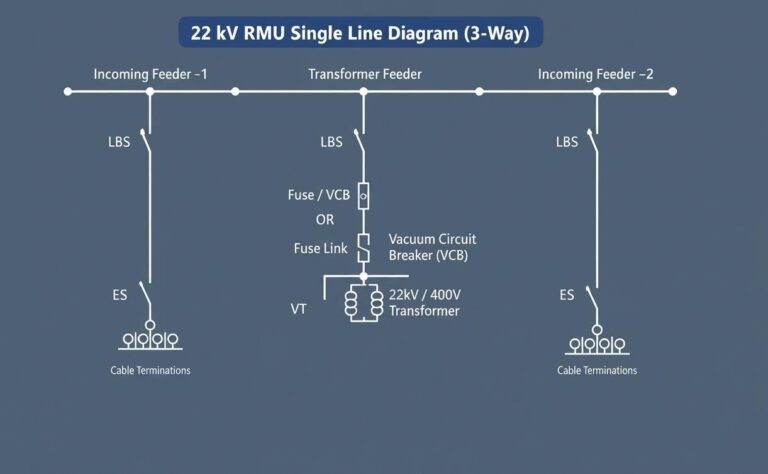
Circuit Breakers in Incoming Feeders and Transformer Circuits
Circuit breakers are typically found in medium-voltage switchgear where a feeder requires dedicated protection and controlled disconnection. Their applications extend beyond transformer protection.
Note on terminology
In IEC markets, switchgear rated 3.6–40.5 kV is called medium-voltage switchgear. In China, the same voltage class is traditionally referred to as high-voltage switchgear. The products on the linked page cover this class.
Application | Installation | Purpose |
|---|---|---|
Main Incoming Feeder | Incoming switchgear panel at a substation or industrial facility | Controls the incoming supply and provides feeder protection |
Transformer Feeder | Medium-voltage panel connected to a power or distribution transformer | Protects the transformer circuit according to the selected protection scheme |
Bus Section or Bus Coupler | Between two sections of a medium-voltage busbar system | Connects or separates busbar sections to support different operating arrangements |
Can a Load Break Switch Provide Fault Protection with Fuses?
A load break switch plus fuse works well for medium-voltage transformer feeders with modest supply capacity, simple feeder setups, and only a few outgoing circuits. It is a practical option when the project does not require complex relay-based protection, automatic reclosing or advanced feeder automation.
Before going with this setup, engineers should know its limits — especially what happens in the system after a fuse blows.
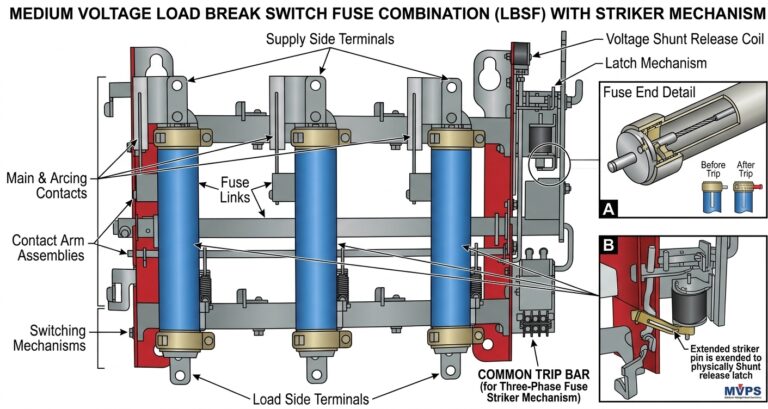
Fuse Replacement and Power Restoration
A fuse is a one-time protective device. Once it operates, the blown fuse link must be replaced before the feeder can go back into service. When a fuse striker fires, the switch-fuse mechanism opens all three phases — but resetting the switch won’t bring the circuit back.
A circuit breaker offers greater operational flexibility. It can open and close again and again, and with the right protection and control scheme, it can even reclose automatically where the application allows. That means the system can restore power after a temporary fault without replacing protective components.
Key Selection Considerations
Even in simple distribution systems, engineers should check three things:
- Transformer Rating. The fuse rating has to match the transformer’s rated capacity and ride through its magnetizing inrush current without blowing.
- Short-Circuit Conditions. The fuse needs enough breaking capacity to handle the prospective fault current at that point in the system.
- Protection Coordination. The fuse’s operating characteristics have to line up with the upstream and downstream protective devices, so the system doesn’t lose power unnecessarily.
So which one do you go with? It comes down to what the feeder needs. If it’s a simple transformer setup with basic protection requirements, a switch-fuse combination does the job. If you need adjustable protection, auto-reclosing, or fancier control functions, that’s where a circuit breaker earns its keep.
Frequently Asked Questions
Not sure whether your feeder needs a load break switch, or a circuit breaker? Send us your single-line diagram and get an engineer’s recommendation.