Arc Flash Protection and Safety
Why Arc Flash Matters to You
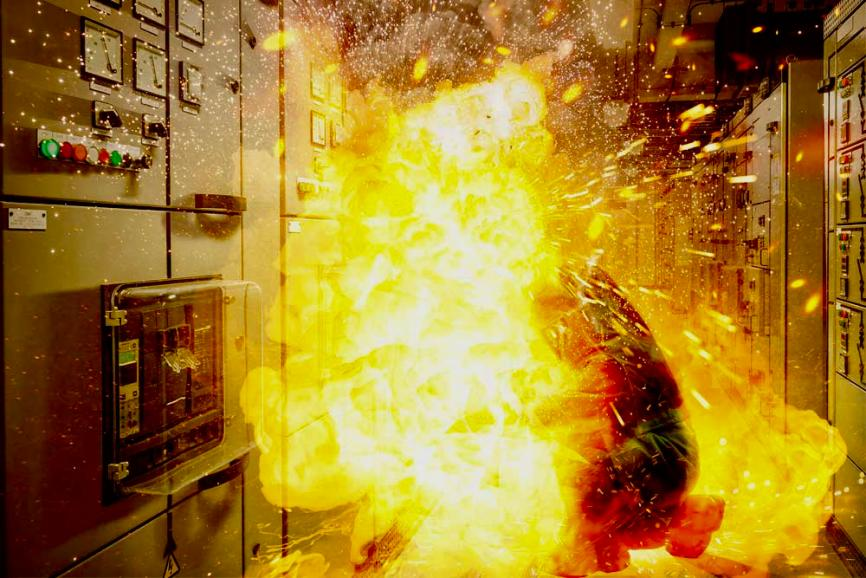
An electrical arc flash can escalate from a regular fault to a deadly explosion in less than a millisecond. The consequences of arc flash can never be underestimated. There are about 30,000 arc flash incidents annually in the United States, resulting in about 7,000 burn injuries, 2,000 hospital admissions, and about 400 deaths. Beyond the human toll, a single event costs an average of $1.5 million in downtime, equipment damage, and OSHA fines. The United States records approximately 30,000 arc flash incidents every year, leading to roughly 7,000 burn injuries, 2,000 hospital stays, and around 400 deaths. Beyond the human toll, a single event carries an average cost of $1.5 million in downtime, equipment damage, and OSHA fines.
What Is Arc Flash?
a plasma discharge
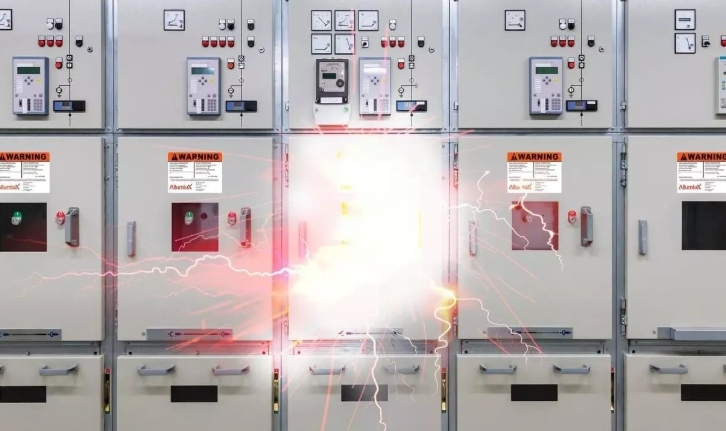
An arc flash is a sudden explosive release of electrical energy. It occurs when a short circuit forms between energized conductors, or sometimes between a conductor and the ground. An electrical fault causes the air between conductors to ionize and become plasma, creating conductive paths for massive current to flow. An arc flash can be very destructive. It is an intense flash of heat and light, an arc blast with tremendous pressure, and the ejection of molten metal debris. Arc flash is considered to be one of the most dangerous phenomena in electrical systems.
The Dangers of Arc Flash
An arc flash event releases multiple deadly hazards all at once:
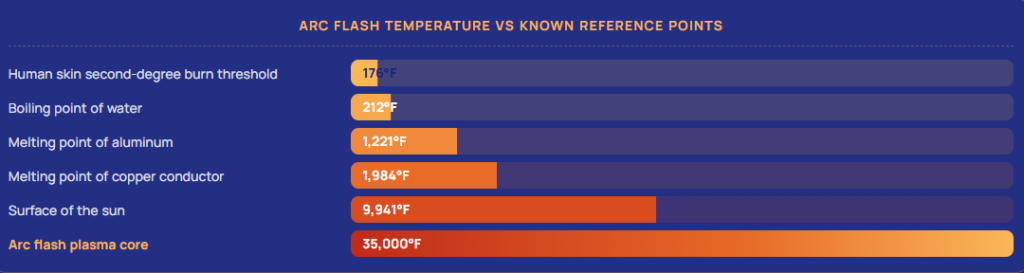
High temperature: An arc flash usually reaches temperatures of approximately 35,000°F (19,400°C), which is hotter than the sun’s surface. Without adequate protection, personnel exposed to such thermal energy would be burned severely in milliseconds. Their clothing would burst into flames in an instant, and synthetic materials would stick to skin, causing catastrophic injuries.
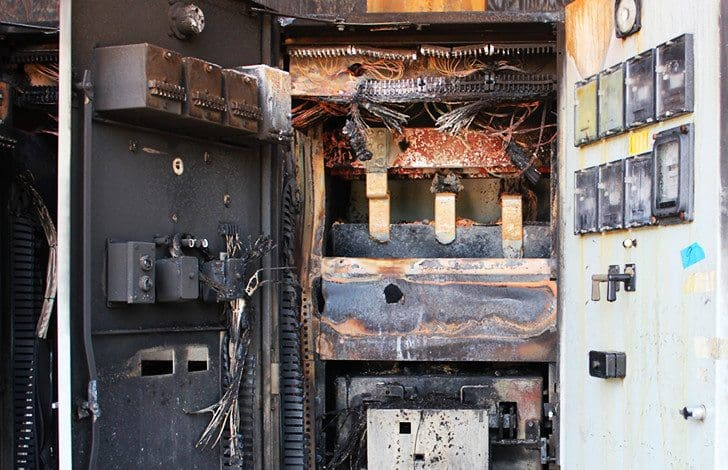
Molten Metal Spray: During an arc flash, copper busbars vaporize and expand to about 67,000 times their original solid volume, shooting molten metal droplets at bullet speeds. These projectiles can easily penetrate common clothing and cause severe puncture burns deep into human’s tissue.
Pressure Wave (Arc Blast): The pressure wave from an arc flash can exceed 2000 pounds per square foot—enough to throw workers backward, causing broken bones, ruptured eardrums, and collapsed lungs. Equipment doors and panels can become deadly shrapnel in an instant.
Intense Light and Sound: An arc flash can produce ultraviolet and infrared radiation that can result in serious or even permanent blindness. The blast can reach over 160 decibels, louder than the noise of a jet engine, which may cause immediate and permanent hearing loss.
What Causes Arc Flash?
Knowing the root causes is the first step to prevention. Common causes are:
Industries at Highest Risk
There are arc flash hazards in more than just power plants. Arc Flash is a hazard to any industry that works around live electrical equipment. High risk areas include:
Power Generation Plants & Utilities
Manufacturing Facilities
Chemical Processing Plants
Construction & Heavy Industry
Data Centers & Telecommunications

Arc Flash Protection & Mitigation Strategies
Training
Training for personnel needs to cover arc flash hazard awareness, safe work practices and approach boundaries, how to read labels and take emergency measures, plus hands-on practical training.
Personal Protective Equipment (PPE)
Proper arc-rated PPE is a must. Key points regulated by NFPA 70E 2024 include arc-rated clothing, face shields, hearing protection, and voltage-rated gloves.

Regular Inspections & Maintenance
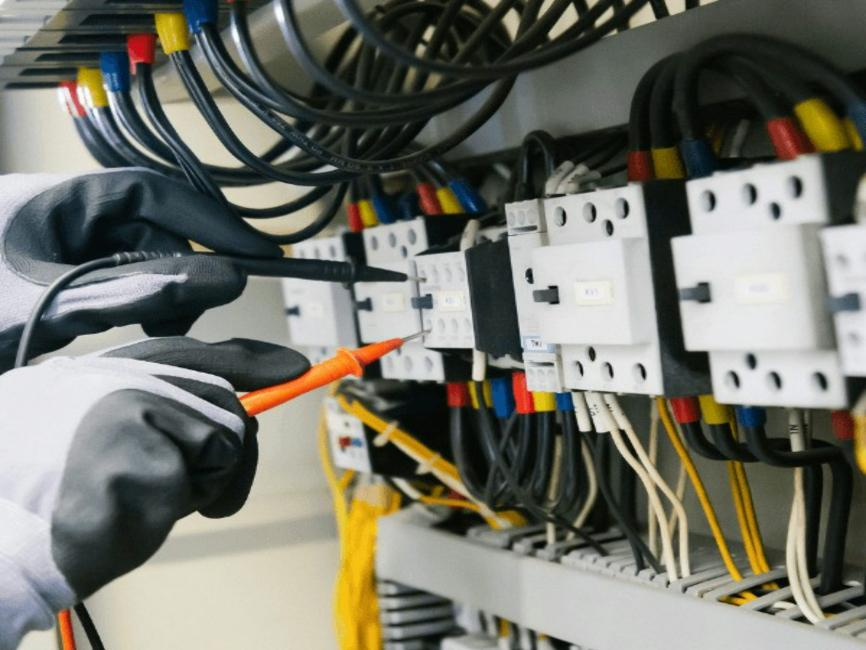
Do routine checks on the switchgear to find and remove possible risks before they become serious problems. Also ensure that the equipment is serviced according to manufacturer recommendations, which helps prevent unexpected failures. NFPA 70B has changed from being a recommended practice to a mandatory standard when it comes to electrical equipment maintenance.
Arc-Resistant Devices
These arc-resistant devices are built to prevent or handle faults inside before these minor mistakes escalate into a serious arc flash. Four key types of protective devices are summarized below.
| Device | Function |
| Fault Current Limiter | When the system operates under normal current flow, the fault current limiter functions in a low-impedance state. During faults they use superconductors to introduce additional impedance, limiting fault current magnitude. |
| Maintenance Switch | Before starting work, the electrician turns on the maintenance switch manually to put the relay in instantaneous-trip mode. In this mode, any faults will trip with zero delay, which can significantly lower the incident energy during arc flash faults and thus minimize the risk of injury to operators. After the job, maintenance switches are turned off and normal coordination resumes. |
| Differential Protection | Differential protection is typically employed in equipment such as generators and transformers. It is activated only when an internal fault occurs. By comparing current entering and leaving a zone, it can isolate fault current instantly upon detecting imbalance. |
| Arc Flash Detection Relay | This special relay uses optical sensors to detect arc flash light intensity and trigger ultra-fast tripping — the higher the light intensity, the faster the response. |
Latest Innovations in Arc Flash Protection
Wireless thermal sensors
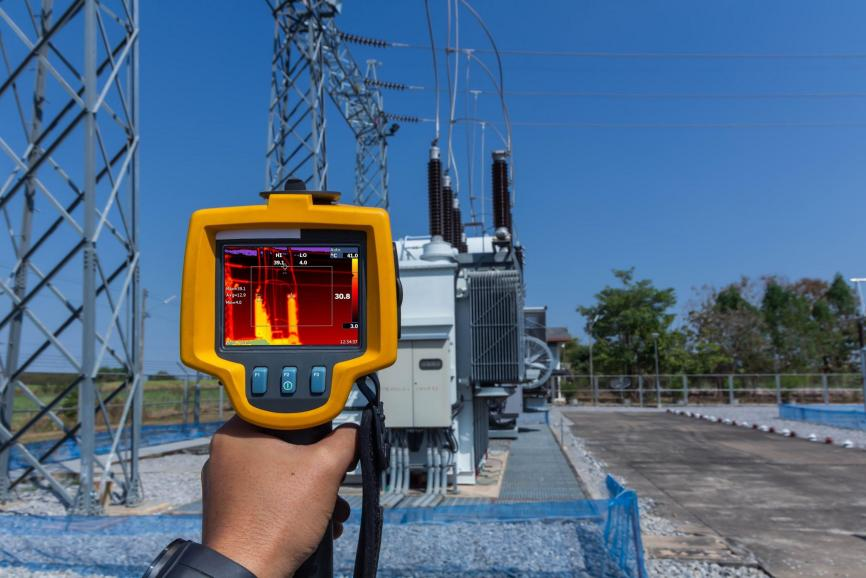
Wireless thermal sensors provide ongoing surveillance of all critical connection points and areas, and they can detect loose connections or “hot spots” that can result in dangerous arc flash events. This is safer than traditional infrared thermography, more comprehensive, and provides diagnostic feedback in real time.
Integrated Digital Switchgear
Integrated digital switchgear is not about making any single part better; it is about making the entire system work as one. It delivers a power distribution solution that is smaller, faster, smarter, and safer than the sum of its parts. It significantly mitigates arc flash exposure by enabling ultra-fast fault detection, remote operation, and predictive diagnostics.
AI-Enabled Predictive Arc Flash Relays
AI-enabled predictive relays continuously analyze waveform signatures, thermal trends, and optical patterns in real time. The machine learning models installed can distinguish between harmless switching transients and real arc signals, and often spot these signals in just a few milliseconds, before the full arc flash shows up. The device can cut false trips by over 60% and help bring fault clearing times down to under 10 milliseconds.
Arc Flash Labeling Requirements
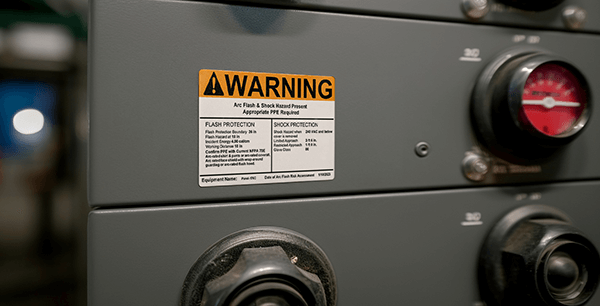
NFPA 70E 2024 Article 130.5(H) requires that arc flash labels include voltage, incident energy, arc flash boundary, site-specific PPE requirements, equipment identifier, and date of the arc flash analysis.
Arc-Resistant Switchgear: Engineered for Survival
Arc-resistant switchgear is defined by ANSI/IEEE C37.20.7 as equipment capable of withstanding internal arc faults and not allowing hazardous energy to reach the person operating it. Unlike standard equipment, arc-resistant switchgear undergoes physical testing before certification. For any workplace with medium- or high-voltage equipment, it turns a deadly accident into a survivable one.
| Feature | Standard Switchgear | Arc-Resistant Switchgear |
| Enclosure | Standard steel | Reinforced heavy-gauge steel with sealed seams to prevent energy leakage from arc flash. |
| Pressure Relief | None | Directed venting channels gases away from operators. |
| Door Latches | Standard | Arc-resistant spring latches withstand blast pressure. |
| Testing | Calculated only | Trial fabric testing proves that the operator’s workstation is free from burn-through per ANSI/IEEE C37.20.7. |
Frequently Asked Questions (FAQ)
Need help upgrading your switchgear to arc-resistant designs? Contact us if you have any questions.