
The “Cheaper” Switchgear Often Costs More: An Engineer’s Guide to AIS vs. GIS
This blog breaks down the differences between air-insulated switchgear (AIS) and gas-insulated switchgear (GIS) and helps you make wise procurement decisions between them.
Is the “Cheaper” Option Really Cheaper?
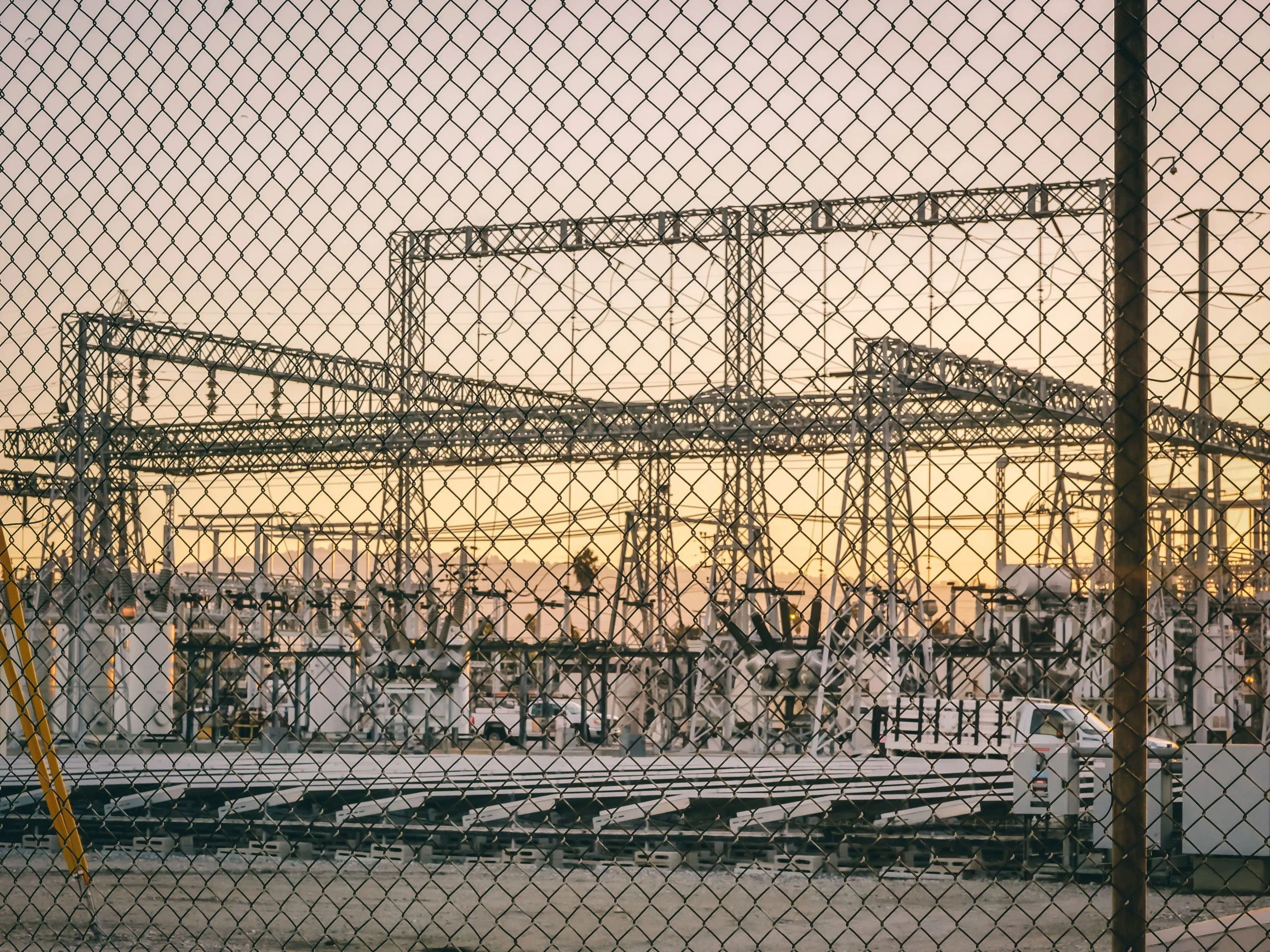
Every substation project starts with a budget line that seems like an easy win: the price of air-insulated switchgear (AIS) is often 50% cheaper than its gas-insulated equivalent, due to its simple steel structures and mature supply chain. The decision almost makes itself on a spreadsheet.
But ask the engineers a decade after commissioning, a different story emerges: breakers need to be overhauled frequently; the switchyard sprawls across land that has since tripled in value. Both AIS and GIS perform identical electrical functions—switching, protection, measurement, isolation—but they differ fundamentally in footprint, lifecycle cost, and environmental impact. As grids urbanize and land values climb, what looks like a bargain at procurement can turn out to be only the first installment on decades of hidden costs — land, maintenance, and outages.
Quick Comparison
Parameter | AIS | GIS |
Insulation medium | Atmospheric air | Pressurized SF6 / eco-gas |
Footprint | Very large | Small (around 10% of AIS) |
Initial cost | Low (around 50% of GIS) | High |
Service life | 30-40 years | 40-50 years |
Maintenance | Every 2-3 years, frequent inspection | 15–25 year intervals |
Environmental Resilience | Exposed, pollution-prone | Fully sealed, immune |
Safety | Lower than GIS | High |
Expandability | Excellent | Moderate, needs planning |
Global warming liability | No | Yes (because of SF6) |
What Is Air-Insulated Switchgear (AIS)?
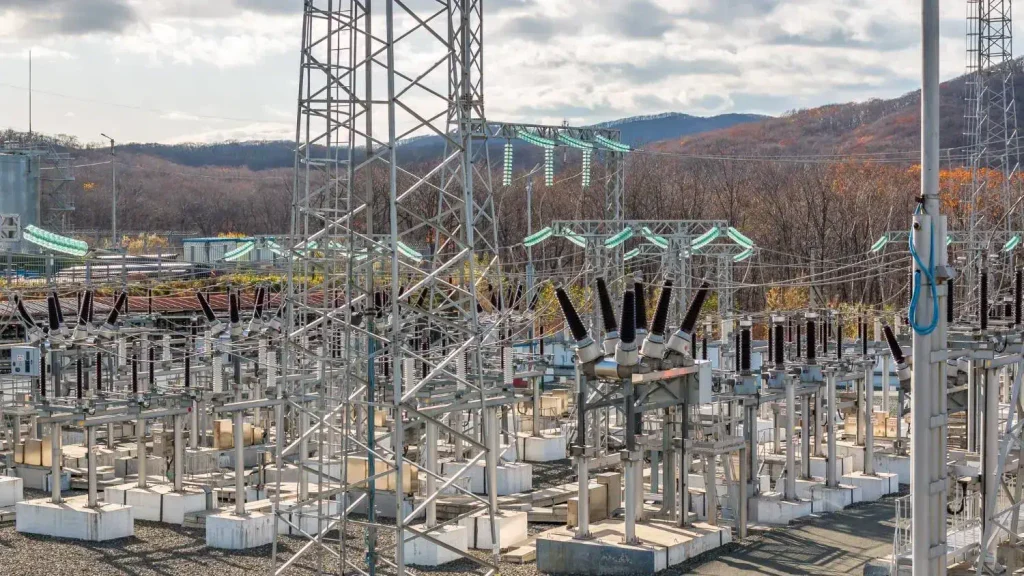
AIS is the old technology that has served power networks for over a century. It uses atmospheric air at ambient pressure as the insulating medium between live conductors and grounded structures. Due to the relatively low dielectric strength of air, AIS needs large clearances between phases and to earth, resulting in a large physical footprint. AIS has exposed components that need frequent maintenance. AIS is available for a wide range of voltage levels from distribution level to 800 KV and above in transmission applications.
What Is Gas-Insulated Switchgear (GIS)?
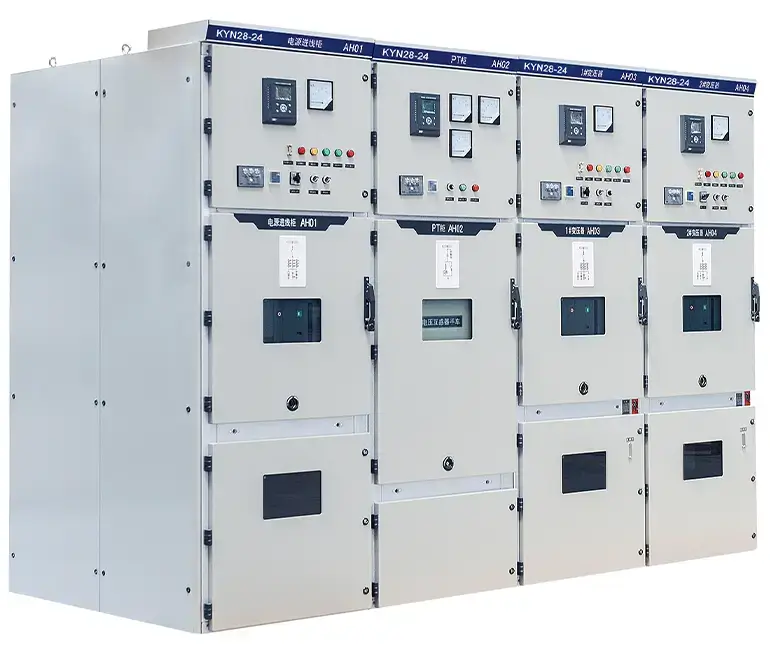
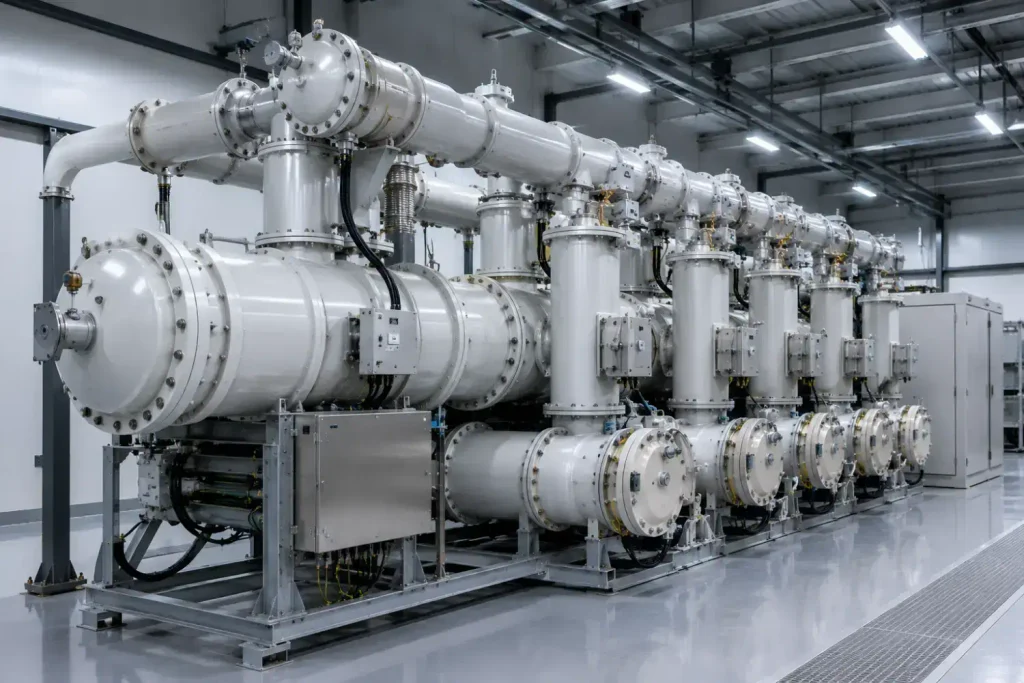
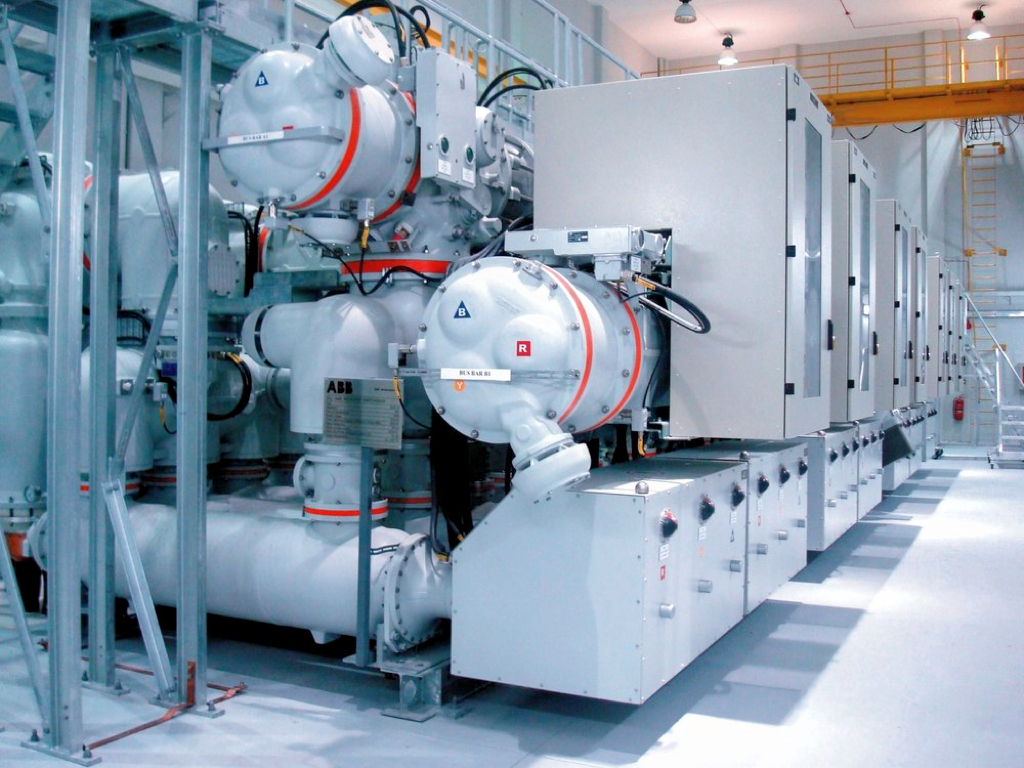
GIS takes the opposite approach: all live components, including circuit breakers, disconnectors, earthing switches, current and voltage transformers, and busbars, are enclosed within a metal-sealed enclosure filled with pressurized insulating gas. Traditionally, that gas is sulfur hexafluoride (SF6), whose dielectric strength is roughly three times that of air, allowing conductor clearances to shrink dramatically.
In recent years, driven by increasingly stringent environmental protection requirements (EU Regulation 2024/573), lower-GWP gas mixtures, such as fluoronitrile (C4F7N), and GIS systems employing vacuum switching technology have gradually matured and been deployed in practical applications.
GIS is delivered as factory-assembled, type-tested bays — typically at 4–6 bar gas pressure — and covers applications from 12 kV distribution up to 1,200 kV ultra-high voltage, governed internationally by IEC 62271-203 for voltages above 52 kV.
The Eight Dimensions That Matter
Footprint
Space is the single most decisive factor. For a typical 132 kV substation, AIS may require at least 4,000–6,000 m² of open yard, while the equivalent GIS fits within 400–700 m² of indoor floor area. The compactness of GIS enables installations AIS simply cannot achieve: underground city-center substations, indoor stations within commercial buildings, offshore platforms, and metro traction substations inside tunnels.
Initial Cost
AIS typically requires 50% less initial investment than GIS, owing to simpler technology and competitive material supply chains. However, lifecycle analysis frequently reverses this picture: GIS saves on land acquisition, civil works, and decades of maintenance labor. Research has confirmed that the total lifecycle cost of GIS falls below AIS in dense urban applications once land value, maintenance labor, and outage risk are included.
Service Life
AIS is typically designed for a 30–40 year service life. Its longevity is limited not by any single component but by accumulated environmental exposure, such as degraded insulators or corroded steel structures, etc.
GIS, by contrast, is engineered for 40–50 years of service, and field experience increasingly supports even longer durations. GIS can perform well even in harsh environments, so the main factors that impact its degradation are the circuit breakers and the long-term gas tightness. GIS breakers are typically designed for 10,000–20,000 operating cycles, which is far beyond what a substation demands over half a century. Gas density is monitored continuously in GIS in case of damage caused by leakage.
Maintenance
AIS demands frequent attention: annual insulator cleaning in polluted areas, contact resistance checks every 2-3 years, and circuit breaker overhauls every 5–8 years. The maintenance needs of GIS are not quite as frequent. Mechanical checks can be conducted every 10–15 years, and full overhauls only every 20–25 years.
GIS incorporates continuous gas density monitoring for each compartment (per IEC 62271-203), supplemented by periodic partial discharge detection according to relevant standards. The repair of GIS needs specialized gas-handling equipment, trained personnel, and longer restoration times, whereas AIS components can often be replaced on-site within hours.
Environmental Resilience
The performance of AIS is limited by site conditions. Salt spray, industrial pollution, dust, humidity, icing, and intrusion by wildlife all increase the arc flash risk and the burden of inspection. In contrast, GIS completely isolates the main circuit from the environment. The dielectric performance of GIS is stable for decades even in the Arctic, desert, or offshore.
Safety
In AIS, live parts are exposed, demanding rigorous clearances, interlocks, and fencing; arc-flash exposure is a genuine hazard during operation. The metal enclosures of GIS encapsulate all energized parts, greatly reducing electric shock and arc-flash risk while also cutting operational noise by an estimated 30–50%. According to industry data, the failure rate of GIS circuit breakers and disconnectors is approximately 25% of that of their AIS counterparts, with a mean time between failures several times higher.
Expandability
AIS remains the most readily expandable architecture: additional bays can be incorporated with relative ease as the substation grows. GIS extensions, by contrast, demand careful coordination of gas compartments, enclosure dimensions, and manufacturer-specific interfaces. Future bays in GIS should therefore be planned and reserved from day one.
Global Warming Liability
GIS equipment is usually filled with SF6, which has a global warming potential (GWP) of 23,500 times that of CO₂. It can even persist in the atmosphere for over 3,000 years. AIS uses air, which is more environmentally friendly. Modern GIS leakage rates sit below 1%, but regulation is tightening. The EU’s Regulation (EU) 2024/573 is phasing down SF6 in new switchgear, with total bans for most voltage classes by 2032. SF6-free GIS now uses either vacuum interrupters with clean-air (dry air/nitrogen-oxygen) insulation for ratings up to 145 kV, or fluoronitrile (C4F7N) blends for higher voltages. The technologies of the two alternative options are getting increasingly mature nowadays.
Recommended Scenarios for AIS VS. GIS
AIS:
GIS:
Don’t Forget the Hybrid Option
Another option deserves mention: hybrid GIS (HGIS), also known as mixed-technology. It bundles the circuit breaker, disconnectors, earthing switches, and instrument transformers into a single factory-assembled, gas-insulated module, while the busbars remain air-insulated. HGIS has many of the GIS advantages: long overhaul intervals and little sensitivity to pollution and humidity. With identical voltage and a similar configuration, an HGIS bay usually takes about 40–60% of the AIS footprint, though it still ends up clearly larger than GIS.
HGIS also has some unneglectable drawbacks. The busbar system in HGIS remains exposed, and the gas compartment still requires the same monitoring regime as GIS, and future extensions remain constrained. HGIS can provide an option for specific situations, such as semi-urban sites, moderate pollution, and budgets that cannot afford full GIS. The factory-assembled module also cuts on-site installation and commissioning time by an estimated 40% relative to AIS.
Conclusion
Two common misconceptions persist in the industry. The first judges AIS to be the more economical option based solely on upfront capital cost, while overlooking its long-term lifecycle expenses including land, maintenance, and overhaul. The second treats GIS as a straightforward successor to AIS, dismissing the advantages of air-insulated switchgear altogether. These misconceptions both lead to bad procurement decisions.
AIS and GIS are not competing generations but two engineering philosophies, each optimized for a different set of constraints, and each likely to remain the right option in its own domain for decades to come. The enduring principle is unchanged and worth repeating: specify by scenario, not by fashion. The selection should start from the site constraints and be settled by many practical factors.
Frequently Asked Questions (FAQ)
Still have questions? Contact our engineers for free procurement suggestions.