
IEC TS 61641:2026: What Changes in LV Switchgear Internal Arc-Fault Protection?
November 24, 2026
IEC TS 61641:2026, published on August 19, 2026, applies to low-voltage switchgear and controlgear assemblies conforming to the IEC 61439 series. Two things that used to sit in separate technical documents, passive arc protection and the integration of active arc mitigation systems, now share one specification.
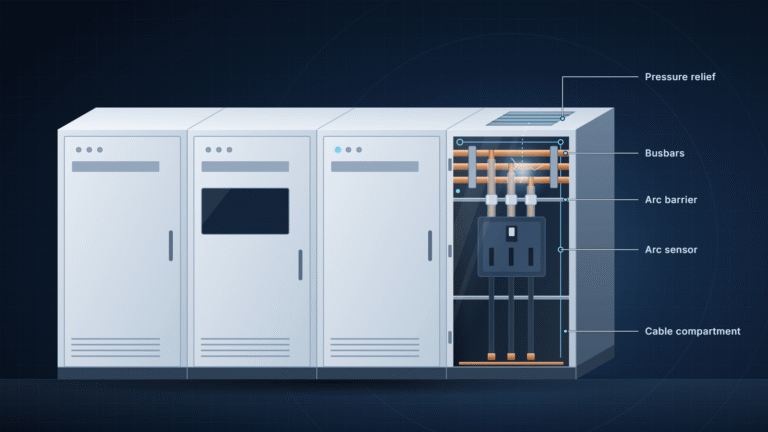
An assembly built to IEC 61439 can still suffer an internal arc fault. Foreign objects left behind during manufacturing, installation or maintenance, component defects, aged insulation, loose or faulty connections and improper operation can all contribute to such faults. Once an arc forms inside the enclosure, temperature and internal pressure climb within milliseconds. Doors and covers are forced outward, hot gases and glowing particles may be expelled, and the equipment inside is damaged.
The IEC 61439 series sets design, construction, performance and verification requirements for normal operating conditions, and an internal arc fault is not one of them. IEC TS 61641:2026 adds verification methods for it, aimed at three things: limiting the risk of injury to personnel, keeping equipment damage within acceptable limits, and improving the availability of power after an internal arc event.
What Has Changed in IEC TS 61641:2026?
A Unified Framework for Passive and Active Arc-Fault Protection
IEC TR 61641:2014 gave testing guidance for low-voltage assemblies under internal arc conditions and concentrated on passive containment by the enclosure. The integration and testing of Internal Arc-Fault Mitigation Systems (IAMS) in those assemblies was handled separately, in IEC TS 63107:2020. The 2026 edition covers both in one document and keeps a third route, the Arc Ignition Protected Zone, which lowers the probability that an arc starts at all.
The three routes work on different principles:
Protection Approach | Primary Mechanism | Core Focus |
|---|---|---|
Passive Protection | Limits arc effects through mechanical structures such as door locks, hinges, barriers, and pressure relief devices | Controlling internal pressure, thermal effects, and the outward expulsion of glowing particles |
Active Protection (IAMS) | Detects internal arcs and reduces released energy via an arc mitigation device | Reliable detection, timely actuation, and system-level coordination across the assembly |
Arc Ignition Protected Zone | Reduces the likelihood of arc initiation within a designated space through insulation and structural measures | Lowering arc probability at the source and containing the risk of fault propagation |
The routes are not mutually exclusive. An assembly can combine them, and what the standard looks at is whether the assembly, or a designated section of it, passes the corresponding verification.
From Arcing Classes to Defined Arcing Class Zones
The revised specification introduces the Arcing Class Zone and draws a line between Area and Zone. An Area is the installation environment outside the equipment, together with who can get close to it. A Zone is a defined volume inside the switchgear.
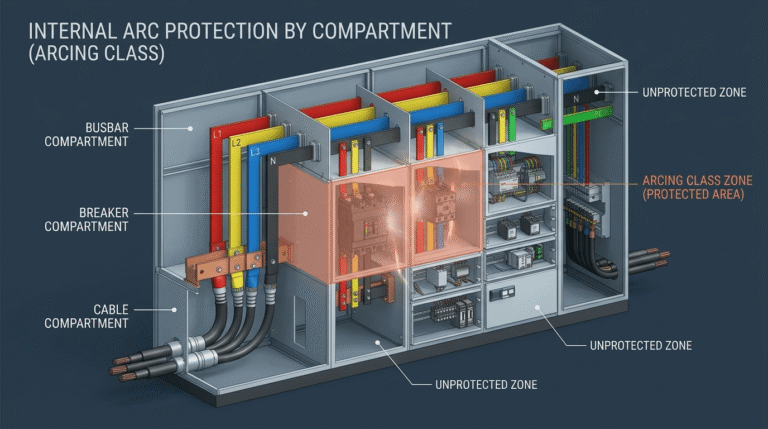
The original assembly manufacturer defines the Arcing Class Zone, which can cover the entire switchboard or only one or more compartments. If only certain compartments have been verified for internal arc protection, the test results belong to those spaces and do not extend automatically to the whole assembly.
Assembly Protection now has two tiers. The first restricts the effects of an internal arc to the zone the manufacturer has defined; the second starts from that containment and also allows continued operation after a fault, under specified conditions. Enhanced Protection is defined separately. Its aim is power availability, through lower arc energy and a shorter time to return equipment to service, and it further reduces the mechanical and thermal hazard to personnel.
Why Do the New Protection Levels Matter?
Beyond Personnel Safety: Equipment Protection and Power Availability
Busbars, insulating supports, circuit breakers and termination joints all take the thermal and pressure load of an internal arc. Even where the enclosure keeps hot gases and glowing particles from escaping, parts inside may still need inspection, cleaning or replacement.
IEC TS 61641:2026 writes post-fault power availability into its verification objectives. In an assembly with an IAMS, the mitigation device can shorten the arc or divert the fault current, which reduces the energy released and, with it, secondary damage to equipment. If the affected area stays contained, maintenance teams may only need to service the faulted section rather than inspect and rebuild a much larger part of the switchboard.
Two operational objectives need to be told apart:
- Assembly Protection with Limited Operation: whether the equipment can keep operating under defined constraints after an internal arc fault.
- Enhanced Protection: how much time and work it takes to restore power. Lower arc energy also reduces the mechanical and thermal risk to personnel.
In industrial facilities, commercial buildings and other operations that depend on continuous power, both bear on how an internal arc protection scheme is specified.
Why Reliable IAMS Operation Matters?
Routine switching can produce brief transient arcs, and in systems that detect arcs optically the flash may be enough to cause an unintended operation. An IAMS that trips during normal switching means avoidable downtime; one that fails to detect or mitigate a real fault leaves the assembly without the protection it was meant to give. IEC TS 61641:2026 therefore looks beyond fault detection. It evaluates how the system operates inside the complete assembly, whether unintended actuation is prevented, and how the system behaves right after energization.
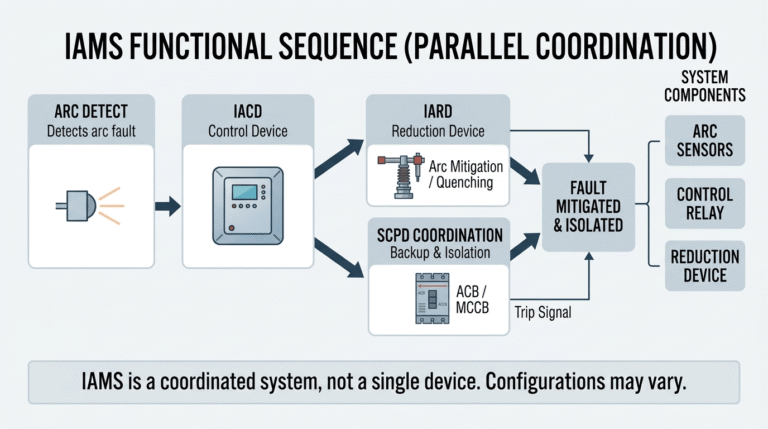
Verification follows the whole chain: whether the sensors detect the internal arc, whether the control unit issues the correct trip signal, whether the mitigation device carries out its action, and how these coordinate with the short-circuit protective devices. Behavior at initial energization or re-energization carries equal weight. The protection of a whole assembly cannot be judged from the response time of an individual relay or sensor alone.
What Should Buyers Verify in Internal Arc-Fault Test Reports?
Protected Zones and Test Conditions
When procuring low-voltage switchgear, buyers should first look for the exact spaces an internal arc test report says were verified. A label such as Arc-Resistant or Arc-Tested does not say that.
The documented Arcing Class Zone may cover the complete assembly or only particular compartments, and either way it has to be read against the installation Area and the personnel accessibility conditions on site. The rated operational voltage, the prospective short-circuit current under arcing conditions and the fault duration used in testing should match the project’s electrical parameters. For solutions that rely on an upstream or integrated short-circuit protective device to achieve its rating, the settings and model of that device should be verified too.
The tested configuration must also match the equipment actually supplied. A change to the enclosure geometry, door locks, internal barriers, pressure-relief vents, busbar arrangement or major switching components can alter the pressure-relief path and the way the assembly responds during an arc. If a report rests on a reference design or representative configuration, procurement teams should confirm that the supplied model and build fall within what was verified.
System Integration and Verification Results
Datasheets for the sensors, controller or mitigation device, read in isolation, do not show how the complete switchboard will perform. The test report and its technical documentation should describe the IAMS architecture: how many sensors there are, where they sit, and how the Internal Arc-Fault Control Device (IACD), the Internal Arc-Fault Reduction Device (IARD) and the Short-Circuit Protective Device (SCPD) work together. The records should also show that verification covered internal arc detection, correct protective actuation, and immunity to unintended tripping during routine switching and similar operating events.
Functional verification at energization and re-energization deserves a look too. Where a project requires rapid power restoration after a fault, buyers should find out how the post-fault condition of the equipment was assessed in testing, and which zones qualify for limited continued operation or faster re-commissioning. That says more about real-world performance than a single component response time.
The scope of IEC TS 61641:2026 has limits. It supplements the IEC 61439 series for low-voltage assemblies, does not replace the product standards for individual components, and does not apply to the integration verification of Arc Fault Detection Devices (AFDDs) under IEC 62606. Toxic gases, intense light and acoustic noise fall outside it, as do maintenance procedures and personal protective equipment.
For information on personnel protection, maintenance, and on-site safety measures, please refer to Arc Flash Protection.
Conclusion
Internal arc protection used to be judged by whether the enclosure limited injury and physical damage at the moment of the fault. IEC TS 61641:2026 adds arc energy, the reliable behavior of active mitigation systems and power availability after the fault to the assessment.
An arc-tested label alone says very little about a low-voltage switchgear assembly. Which zones were verified, under what electrical conditions the test was run, whether the delivered build matches the tested design, and how an active system behaves in both fault and normal switching states decide what a test report means for a given project.