EU F-Gas Regulation for Medium-Voltage Switchgear: 2026 Rules and the 2030 Deadline
November 24, 2026
A 12 kV switchgear assembly is built in December 2025 and reaches an EU project site before the year is out. Its functional tests and inspections are not finished until 5 January 2026, and only then is it handed over to the operator. Having been manufactured and shipped ahead of the cut-off, can it still use SF₆?
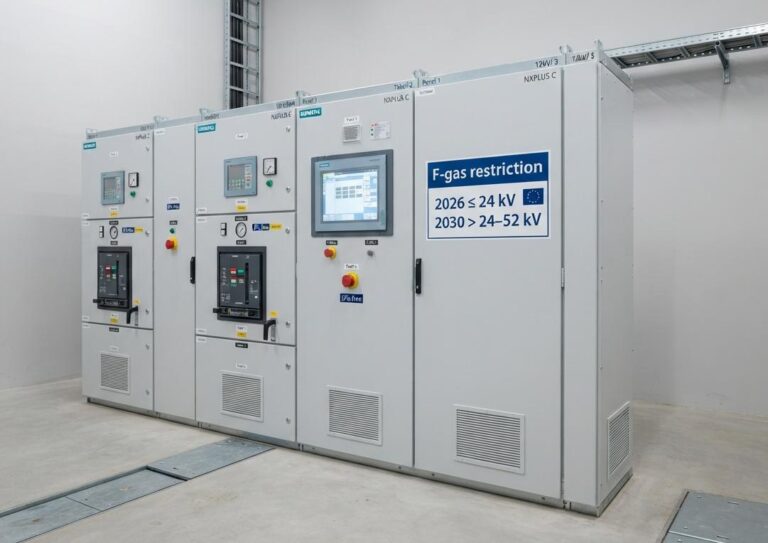
Those dates alone won’t settle it. Regulation (EU) 2024/573 restricts F-gases in switchgear mainly by reference to when the equipment is put into operation, and the applicable date depends on rated voltage.
From 1 January 2026, switchgear for primary or secondary distribution rated up to 24 kV may no longer use F-gases as an insulating or arc-quenching medium. Equipment rated above 24 kV and up to 52 kV follows on 1 January 2030. The first stage is therefore already in force, and 12 kV and 24 kV equipment has to be specified to the current rules.
Manufacturers are not the only ones affected. For EPC contractors and buyers, the rated voltage, the insulating and arc-quenching medium, and the date the project goes into operation can each bear on the final assessment. The regulation also keeps exceptions for orders placed early and, in particular cases, for projects that cannot obtain compliant equipment.
Which Medium-Voltage Switchgear Is Covered by the EU F-Gas Regulation?
Scope of the F-Gas Restrictions
Article 3(33) of Regulation (EU) 2024/573 defines electrical switchgear broadly. Circuit breakers and disconnectors are included, together with their control, measuring and protection equipment and the enclosures around them. The restrictions discussed in this article concern switchgear used in primary and secondary distribution, specifically where F-gases serve as the insulating or arc-quenching medium, or where the equipment cannot operate without them.
The rules reach beyond public grids to privately operated distribution networks, such as those at industrial plants and airports. Generator circuit-breakers are a different matter: the Commission’s FAQ expressly leaves them out, since they are specialised equipment.
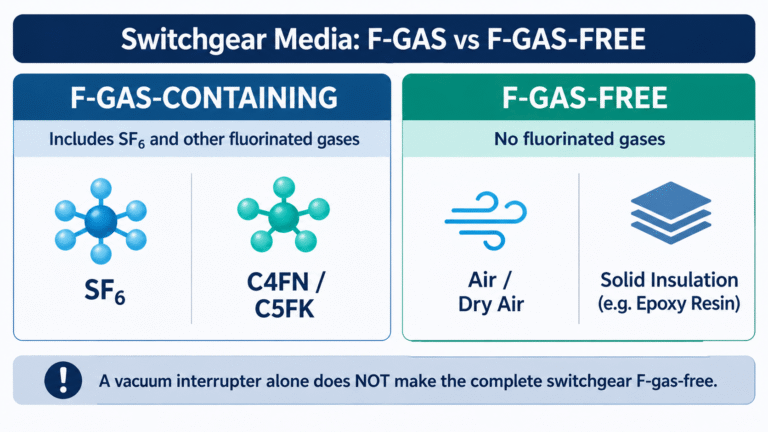
SF₆ is the F-gas most often found in switchgear, though not the only one. Fluoroketone (C5FK) and fluoronitrile (C4FN) are in the same family. All of them are fluorinated greenhouse gases covered by Annexes I to III, and whether they are used alone or blended, the equipment has to be assessed under the Regulation. For mixtures, the GWP is calculated with the method set out in Annex VI.
F-Gas Deadlines by Switchgear Rated Voltage
Article 13(9) establishes different implementation dates based on the rated voltage. For medium-voltage switchgear, the restrictions are introduced in two phases:
Rated Voltage | F-gas Restriction | Ban Effective Date |
|---|---|---|
≤ 24 kV | No F-gases permitted | January 1, 2026 |
> 24 kV to ≤ 52 kV | No F-gases permitted | January 1, 2030 |
Swapping SF₆ for another fluorinated gas with a lower GWP does not make equipment rated up to 52 kV compliant. What matters is whether the substitute is still an F-gas under the Regulation’s definition, and that is something buyers need to check.
Above 52 kV, the Regulation sets separate limits for 2028 and 2032 and permits F-gases with a GWP below 1. This article does not cover that equipment, since the requirements for it are different.
Why Equipment Rated Voltage Matters?
The applicable date follows the design rated voltage of the switchgear itself, not the nominal voltage of the network it is connected to. An SF₆ unit designed for 35 kV is subject to the 2030 date even if it is installed on a network supplied at below 24 kV.
Ratings such as 35 kV, 36 kV and 40.5 kV appear under different standards and in different product catalogues, yet under this Regulation anything above 24 kV and up to 52 kV falls into the same band. On a multinational project that is easy to overlook.
What Counts as Putting into Operation, and When Are Exemptions Allowed?
What Does “Putting into Operation” Mean?
Under Question 6 of the Commission’s FAQ, equipment is generally treated as put into operation when it is handed over to the operator, once the necessary functional and performance tests and other checks have been completed. It does not have to be energised or connected to the grid.
In the opening example, the 12 kV unit was handed over on 5 January 2026, after the first restriction had taken effect. If it uses SF₆ as its insulating or arc-quenching medium and no exemption applies, that handover date is where the compliance problem arises.
According to the FAQ, the operator is the undertaking with actual control over the technical functioning of the switchgear. Where one undertaking is responsible for putting the equipment into operation, it is treated as the operator, with the compliance responsibilities that follow, until the equipment is legally handed over to another.
On an EPC project, the equipment manufacturer, the installation contractor and the eventual operator cannot divide every regulatory responsibility by the purchase contract alone. Who puts the equipment into operation, and when the legal handover takes place, should be stated in the project documents.
What About Existing SF₆ Switchgear?
SF₆ switchgear already in operation does not have to be taken out of service when the 2026 or 2030 date arrives. Article 13(9) is aimed at equipment put into operation afterwards, and units already running may stay in use, though their operators remain subject to the other F-gas management requirements.
From 1 January 2035, maintenance and repair of electrical switchgear will be permitted only with reclaimed or recycled SF₆. For emergency repairs, the Regulation keeps specific exceptions where such gas cannot be obtained or there is a technical obstacle to using it, but supporting documentation has to be kept.
Under Article 13(14), an exception is available where the operator can show that the switchgear was ordered before 11 March 2024. What counts is the signing date of the order for the specific equipment. The FAQ explains that the signing date of a framework agreement can serve only if that agreement already specifies the equipment and its delivery arrangements.
When Can F-Gas Switchgear Qualify for a Derogation?
The Regulation allows F-gas switchgear to be put into operation under a statutory derogation in certain circumstances.
First case: no compliant tenders, or insufficient competition.
If no tender meeting the general restrictions arrives for a given use and installation site after the restriction date, equipment using an F-gas with a GWP below 1,000 may be put into operation. The same applies where, for two years from that date, only one manufacturer submits a compliant tender. The other conditions still have to be met.
Second case: not even a GWP-below-1,000 option is available.
Article 13(12) permits other technologies, SF₆ included, where the procurement shows that no F-gas with a GWP below 1,000 can be obtained as an insulating or arc-quenching medium for the project’s specific use.
An operator does not have to run several tender rounds, testing F-gas-free technology, sub-1,000 GWP technology, and conventional SF₆. A single procurement that does not restrict the type of insulating or arc-quenching gas can be used to show the supply position for both tiers of derogation. The supporting material has to be kept for at least five years and produced on request to the competent authority or the Commission. An operator using the procurement-based derogation must also notify the competent authority of its Member State.
How to Select Switchgear for EU F-Gas Compliance?
F-gas-free medium-voltage switchgear is in service in European distribution networks and industrial facilities. Existing projects show that the alternatives have moved beyond the laboratory, though maturity still has to be assessed separately for each voltage level, equipment design and set of project conditions.
Wieland-Werke: 19 Panels in an Industrial Distribution System
When Wieland-Werke, the German copper and copper-alloy manufacturer, built a new 10 kV energy centre and a second 10 kV substation at its Velbert-Langenberg site, it chose the Siemens NXPLUS C 24 blue GIS. Siemens carried out the project together with its EPC partner ETB Electronics GmbH. The scope covered 19 switchgear panels, and was completed in 2023.
NXPLUS C 24 blue uses Clean Air insulation and vacuum interruption. It is rated up to 24 kV, with a rated short-circuit current of 25 kA and busbar current of up to 2,500 A, and Siemens identifies it explicitly as F-gas-free.
EAM Netz: Pure-Air Technology in an Existing Substation
EAM Netz, a German distribution operator, worked with Schneider Electric on a GM AirSeT pilot at its Dörnhagen substation, where 11 switchgear panels were installed.
GM AirSeT combines pure-air insulation with vacuum interruption. According to project material published by Schneider Electric, the equipment was fitted into the existing distribution infrastructure without costly modifications on site. Familiar operating procedures and a compact design were among the considerations in carrying out the project.
For buyers, such projects are a direct reference: a replacement has to meet the regulatory and electrical requirements, and it also has to fit the dimensions of the existing switchroom, the busbar connections, the secondary controls and the way the installation is operated and maintained.
Conclusion
The EU F-gas Regulation has changed what medium-voltage switchgear can be specified for EU projects, both technically and in procurement. Rated voltage decides which restriction date applies, and the date a unit is actually put into operation bears on the assessment. The insulating medium and the supply of alternative equipment then determine which technical options a project can take. Checking these points early is more useful to manufacturers, EPC contractors and buyers than watching the 2026 and 2030 dates alone.